Australian study supports local field peas as a soybean meal alternative in broilers

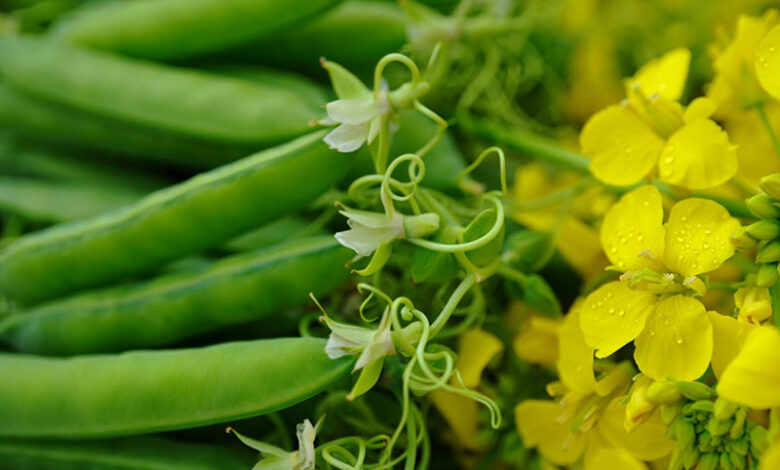
Soybean meal is the main plant protein source in broiler diets because of its high protein content, balanced amino acid profile, and digestibility. But Australia relies heavily on imports, creating interest in local alternatives. Researchers therefore investigated whether soybean meal could be partly or fully replaced by a combination of field peas and canola without affecting broiler growth, digestibility, or carcass traits.
This feeding trail involved 300 Ross 308 (mixed sex) broilers, randomly assigned to 60 pens, with each dietary treatment tested in 10 replicate cages of 5 birds each. The study tested 3 levels of soybean meal inclusions – standard, medium, and low/nil either with or without field pea inclusion.
In total, 6 dietary treatments were fed over a 42-day post-hatch with 4 commercial phases: starter (0-10 days), grower (11-24 days), finisher (25-35 days), and withdrawal (36-42 days). The experiment involved the inclusion of field peas at increasing levels of 50, 80, 100, and 120 g/kg, replacing nearly 45%, 60%, 100% and 100% of soybean meal, in the respective feeding phases. This variation in soybean meal levels led to changes in NBAA inclusion and total dietary crude protein as well. Researchers assessed growth performance, nitrogen retention, and nutrient digestibility during this experiment.
For producers, nutritionists, and feed manufacturers, these practical implications are considerable. Field peas can be safely included at 5-12% of the diet, and soybean meal can be entirely removed during the later growth phases without compromising bird performance.
Poultry World spoke to PhD candidate in poultry nutrition at the Poultry Research Foundation within The University of Sydney, Milan Kandel, who conducted these trials.
Why did you choose field peas and canola products specifically as alternatives to soybean meal in this trial?
Field peas and canola products are readily available in ample amounts in Australia. Field peas are also an important rotational crop in Australian farming systems, contributing to improved soil nitrogen management and overall sustainability.
From a nutritional perspective, field peas contain approximately 232 g/kg crude protein and 488 g/kg starch. Their relatively high amylose-to-amylopectin ratio may slow starch digestion compared with cereal grains, which could improve nutrient utilisation and feed conversion efficiency in broiler chickens.
In addition, including field peas may help moderate the dietary starch-to-protein ratio, which is important for supporting broiler growth performance.
What practical formulation tips would you give to commercial nutritionists trying to replicate this approach?
For commercial diets, we would recommend field pea inclusion levels of approximately 5% in starter, 8% in grower, 10% in finisher, and 12% in withdrawal diets, based on the results of this trial. A key practical finding was that the finisher and withdrawal diets, which contained field peas and the highest inclusion levels of non-bound amino acids, were completely soybean meal-free. Importantly, this reduction of soybean meal did not compromise broiler growth performance.
This suggests that a phase-feeding strategy, with gradual increases in field pea inclusion across successive feeding phases and appropriate balancing with non-bound amino acids, can be a practical approach for commercial nutritionists seeking to reduce soybean meal dependence without compromising the performance of broiler chickens.
How surprising were the improvements in BWG and FCR with field pea inclusion, given that soybean meal is often considered the “gold standard” plant protein?
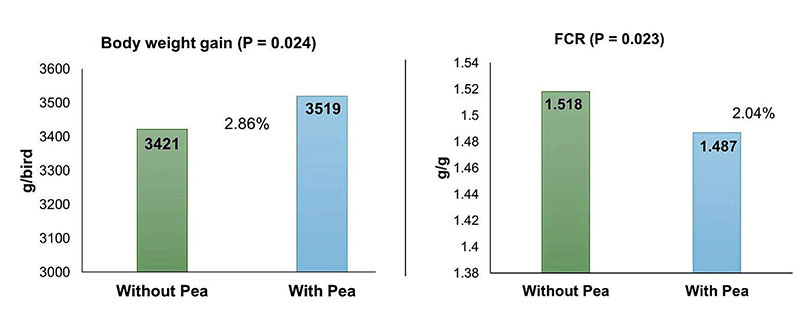
It is encouraging that weight gain improved by 2.9% and reduced FCR by 2.04% (P < 0.05) from 0-42 days post-hatch regardless of the inclusion of soybean meal inclusions. There were no significant differences in apparent starch and protein digestibilities in both the distal jejunum and ileum in diets with or without peas. Additionally, pea inclusions did not influence energy utilisation and total tract nitrogen retention.
Figure 1 – The effect of pea inclusions on BWG and FCR, days 0-42 post-hatch
Were there any “tipping points” in pea inclusion (e.g., 100 vs. 120 g/kg) where you started to see diminishing returns or potential risks?
In this trial, we only included field peas up to 12%, and at that level, we did not observe any clear tipping point, diminishing return, or negative risk. So, within the range we tested, peas appeared to be well tolerated.
Did you assess any meat quality traits?
Yes, we found no significant interaction or main effects on breast meat yield, including both pectoralis major and pectoralis minor, leg quarters, or relative fat pad weight.
Can you share any preliminary observations or hypotheses about how field peas might influence the microbiota, SCFA production, or intestinal morphology?
We did not assess microbiota composition, short-chain fatty acid production, or intestinal morphology in this study, so we cannot draw direct conclusions about those responses. However, legumes are known to promote beneficial host -diet -microbiota interactions and may contribute to improved gut health and growth performance.
Do you think these alternative‑protein diets could have longer‑term health implications?
Yes, I think this alternative protein in the diet could have important longer-term health implications, particularly for litter quality and welfare outcomes such as hock burns or footpad dermatitis. In one of our previous trials, litter moisture was significantly higher in birds fed soybean meal-based diets than in those fed canola-rich diets, and the lower litter moisture in the canola-based treatment was associated with fewer hock burns and footpad dermatitis at day 40 post- hatch.
A possible explanation is that soybean meal contributes more potassium to the diet, which may increase water intake and excreta moisture, leading to wetter litter. So, there may be both environmental and bird health benefits from reducing soybean meal. However, the same study also showed better growth and FCR in the soybean meal-fed birds, suggesting a potential trade-off between production and health outcomes. For that reason, future studies should assess performance, litter quality, welfare, and health together to better understand the overall value of these alternative protein strategies.
In addition, moderate reductions in CP are consistently associated with meaningful improvements in footpad condition, supporting reduced CP diets as an effective nutritional strategy to enhance broiler welfare.
How do you estimate the potential reduction in nitrogen excretion and environmental footprint when SBM is replaced by field peas and canola‑based blends?
In this study, apparent metabolisable energy, AME:GE, nitrogen retention, and AMEn were evaluated from 27-29 days post-hatch. Birds offered diets with no soybean meal showed higher nitrogen retention than birds fed diets containing conventional levels of soybean meal, regardless of pea inclusion (72.73% vs. 70.26%; P = 0.001). This indicates that more dietary nitrogen was retained by the birds and, therefore, less nitrogen was excreted.
From a practical perspective, improved nitrogen retention could translate into lower nitrogen losses to the environment and potentially reduced ammonia emissions from litter. However, because nitrogen excretion and environmental emissions were not measured directly, these outcomes should be considered indicative rather than confirmed.
What is your rough estimate of feed‑cost savings when moving from high‑soybean meal to low‑/no‑soybean meal diets with field peas and canola?
Based on our formulation costs, replacing soybean meal with field pea- canola-NBAA based blends gave modest but consistent cost savings. Although higher NBAA inclusion increased diet cost, the pea-based diets were still cheaper than the corresponding soybean meal diets. If expressed on a cost/kg live weight basis, the benefit is even clearer.
From a broader sustainability perspective, how do land‑use change and transport for local peas and canola compare with imported soybean meal?
From a sustainability perspective, local field peas and canola are attractive mainly because they can reduce dependence on imported soybean meal, which is associated with long supply chains and, in some sourcing regions, land-use change and deforestation risk. In contrast, peas and canola are already part of Australian cropping systems, with peas also contributing nitrogen fixation and rotational benefits. Transport emissions may also be lower with local ingredients, although the biggest benefit is probably avoiding high-risk imported soy rather than freight alone.
What are the biggest limitations or risks you see when replacing SBM with locally sourced proteins?
The main risks in replacing soybean meal with local protein sources are ingredient availability, competition with human food use, and performance issues if inclusion levels are too high. For example, field peas are also used for human food, although lower-grade peas unsuitable for people could still be used in feed. With canola products, the main challenge is that high inclusion levels can reduce feed intake and growth. In one of our previous studies, including 300 g/kg total canola products reduced feed intake by 6.9% and body weight gain by 7%, likely because of higher glucosinolate, fibre, and sulphur concentration and poor pellet quality. So, the key is to use these ingredients strategically and at appropriate inclusion levels
Are you planning to test any other local or alternative protein sources?
Yes, we are currently working with several alternative protein sources, including canola products such as canola seed, conventional canola meal, and high-protein canola meal, as well as faba beans. These ingredients are of particular interest because they can be produced locally in Australia and may offer more cost-effective and sustainable alternatives to imported soybean meal. In addition, we are also exploring the use of non-bound amino acids and single-cell proteins as part of broader strategies to reduce reliance on conventional protein sources while maintaining broiler performance.
Natalie Kinsley
Source: PW (30/04/2026)