In this article, Sebastiane Ebatamehi from The African Exponent gives a comprehensive overview of the country in 10th position in the top 10 poultry-producing countries in Africa in 2025 – Ghana.
Rising populations and urbanisation across Africa are fueling demand for affordable protein. In this regard, the poultry industry is emerging as a significant sector contributing to food security, employment, and economic growth across the continent.
The demand for broiler meat, eggs, and related poultry products in Ghana is growing rapidly, but the local industry still lags far behind, meeting only a small fraction of national consumption. Ghana’s domestic chicken meat production in 2023 was about 50,482 mt, with egg production at 74,374 mt, marking a 15% year-on-year increase in eggs but showing that current meat output remains far below demand.
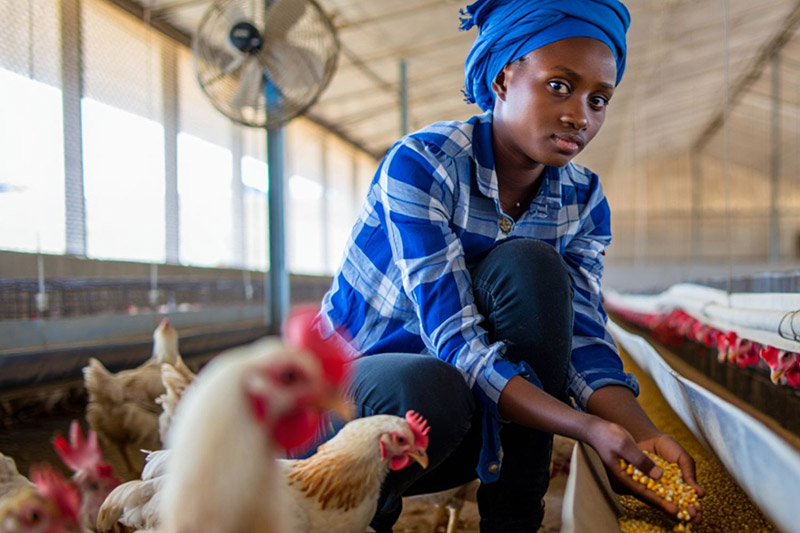
Ralph Ayitey of the Association of Ghana Industries observed in 2025: “This staggering consumption figure serves as a clear indication that our local poultry industry is struggling to keep pace with demand.” Image created with the help of AI (Reve.art)
Second-largest consumer in West Africa
Ghanaians are estimated to consume between 300,000 and 400,000 mt of poultry annually, making Ghana the second-largest consumer in West Africa after Nigeria.
To help close the gap, the government of Ghana rolled out multiple programmes in 2024/2025 to revive and modernise the industry. Key among them is the Poultry Intensification Scheme under the West Africa Food System Resilience Programme (FSRP), funded in part by the World Bank. Under this scheme thus far, about 360,500 day-old chicks, 911,000 vaccine doses, and over 1.17 million kg of feed have been delivered, resulting in the production of 400,000 broiler birds within the first few months of implementation.
Reducing dependance on poultry imports
Ghana has also set specific targets aimed at reducing its dependency on imports. In mid-2025, policymakers pledged to replace at least 25% of the frozen chicken imports (equivalent to about 100,000 mt of poultry meat annually) through intensified local production. Achieving this would require raising roughly 67 million broiler birds per year, or about 1.28 million birds weekly, each yielding about 1.5 kgs of meat after processing.
Challenges for poultry producers
However, challenges in Ghana remain, as they do in neighbouring countries, including high feed and input costs, outdated hatchery and cold chain infrastructure, and stiff competition from cheaper frozen imports from the US, Brazil, and Europe.
Successfully revitalising the local poultry industry in Ghana would have an impact beyond national food security – it would translate into job creation and improve livelihoods. Additionally, reducing imports would conserve foreign exchange reserves, improve trade balances, and encourage value addition in ancillary industries such as feed milling and cold storage.
Natalie Kinsley
Source: poultryworld 01/12/2025